
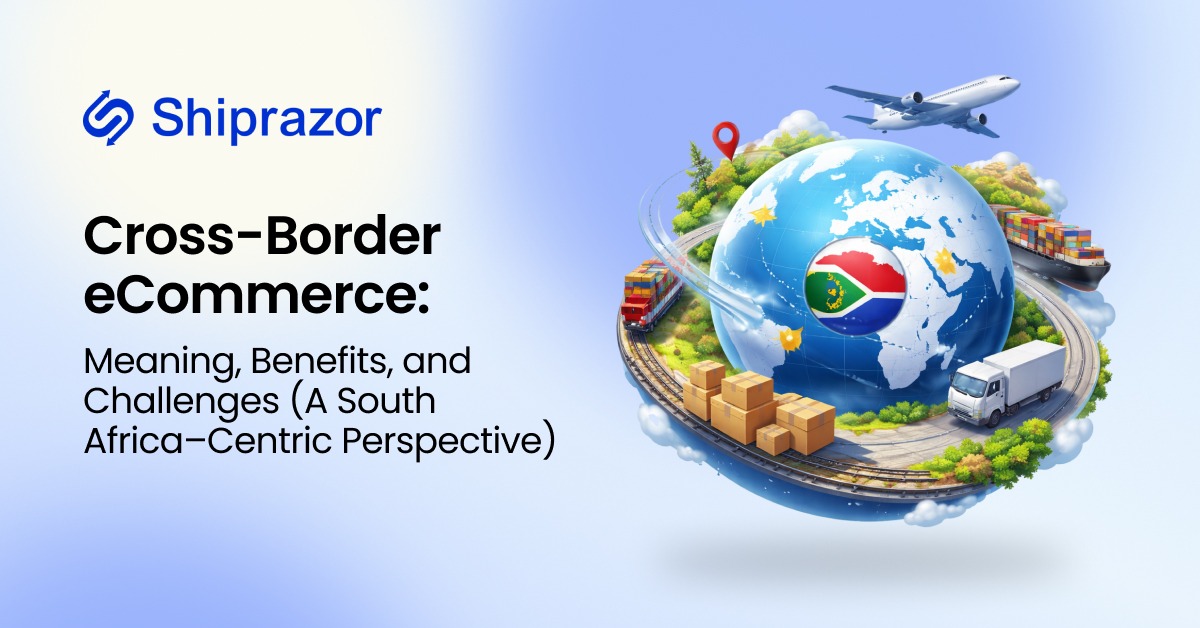
In earlier times, cross-border trade was limited to being a facilitator for global trade. In modern times, it has expanded its scope and become a primary driver for scalability for businesses across the globe. The potential for cross-border trade has expanded in countries like South Africa, where consumers are switching to e-commerce for their everyday needs, and the ambitions of the local entrepreneurs are on the rise. Along with opportunities, cross-border trade has posed its own set of operational challenges, which must be navigated with utmost accuracy by emerging businesses and the giant market players alike.
Cross-Border E-Commerce: Explained
When the e-commerce trade happens between consumers and businesses across different countries and online platforms, we call it cross-border e-commerce. It is different from domestic e-commerce because it involves customs regulations, international shipping, and currencies of different countries. Also, it might be subject to varied consumer expectations. South African businesses have succesfully shipped their goods and services to countries like Asia and Europe, with the aid of cross-border e-commerce. Also, the consumers in South Africa have a new-found access to various international goods which were earlier restricted to other international markets. This has encouraged competitive pricing and a broader product variety in South Africa.
Advantages Offered by Cross-Border E-commerce
Building A Global Customer Base
The consumers are no longer bound by domestic limitations. The domestic market alone has sometimes limited its scope of work. Cross-border commerce has done away with these limitations, and they have made the global markets more accessible than ever before. Therefore, the handcrafted and regional products have been able to gain popularity among international customers.
Diversification of Revenue
If a business relies solely on the domestic market, it will become prone to economic volatility. To diversify their streams of revenue, it has become important for the South African traders to gain their footing in the international market. Also, they would be in a position to reduce their dependence on the local demand fluctuations.
Gaining A Competitive Advantage
By availing the full benefits of cross-border trade, businesses will be in a position to gain an edge over their competitors. They will also be able to get customer loyalty across the globe and a worldwide brand recognition. Also, if they are succesfully able to leverage favourable forgein exchanges rates, the South African local products will become competitively priced in international markets.
Increased Brand Value
A brand’s perception can be revamped by selling its products in the international market. A brand that has made its way into the global market will be considered more credible and superior among its fellow competitors. It can enhance the customer’s trust in the brand and also strengthen its position across the globe.
Potential Challenges for Cross-Border E-Commerce
Competition From Global Players
Although cross-border commerce has opened up various avenues for growth, it has also exposed the South African brands to competition from various industry giants. The small and medium enterprises are now facing challenges in terms of delivery speed, cost-effectiveness, and the rising expectations of consumers. They can make their product valuable through storytelling and a unique brand identity.
Compliances
To make cross-border e-commerce successful in any given country, companies have to face multiple legal frameworks. These might include data privacy mandates, customer protection laws, and international standards for various products. Each region might be subject to its own compliance requirements. It has become important for all businesses to follow these regulations if they wish to avoid legal complications.
Rising Expectations of The Consumers
As consumers become more aware, they start expecting rapid deliveries of their product, a hassle-free exchange, and real-time tracking. Businesses in South Africa always face the risk of suffering due to various logistical and infrastructural constraints. The managing of returns can prove to be an expensive and complicated process. The companies must enhance customer satisfaction by clearly stating the consumer guidelines and also consider local warehousing as a possible solution for quick deliveries.
Complexities Related to Deliveries
One of the biggest challenges faced by South African businesses is that of logistics. They always remain prone to longer delivery times, higher costs, and delays, which can be caused by customs clearance. South Africa has succesfully established regional trade, but it still faces complications while transporting the goods to Asia and North America.
Issues In Terms of Payment and Currencies
To deal with various international payments, a company needs to have a stronghold over multiple currencies and exchange rate fluctuations. A customer might also have varied payment preferences. The digital payments in South Africa have evolved at a significant rate, but they must also ensure that these payment methods are globally accepted. If it is not effectively managed, it can also lead to reduced profit margins.
Regulations and Duties
A different set of regulatory compliances is applicable to different countries. For businesses that are new to these compliances, it can become overwhelming for them to navigate through these frameworks. A company can become liable for shipment delays, penalties, and even the confiscation of goods if it does not follow standard procedures for documentation. They must ensure accurate paperwork and a clear knowledge of the updated international trade policies.
How Can Cross-Border Commerce Attain Its Full Potential?
In order to achieve the full potential of international trade, a business must follow a strategic approach. To ensure efficient shipping and delivery of products, they must only partner with reliable courier partners. Apart from this, they also need to invest in localized marketing. This would further include a language and cultural adaptation. To understand the behavior and preferences of customers across the globe, they must make full use of data analytics.
Companies also need to use digital marketplaces that can help them gain visibility in the international markets. As the trade barriers continue to reduce, companies need to learn how to exploit all the opportunities that are provided to them within regional trade.
Future of Cross-Border Commerce
The economic future of South Africa will be largely dependent on cross-border e-commerce. As the regional integration gets strengthened with the trade agreements and the digital infrastructure continues to improve, businesses will eventually look forward to the international markets to achieve their full potential. If a business can balance complexity with opportunity, it will be able to thrive in the international market.
With the evolution of the global landscape, companies need to invest in consumer experiences, logistics framework, and compliance. In this way, they will be able to gain a competitive edge and ensure the success of their business. It has given the South African businesses an effective way to scale their operations on a global landscape and innovate at a rapid pace. As we move towards an interconnected world, only those businesses that can adapt to these changes will be able to survive and thrive in the global economy.
Sign up today to start cross-border ecommerce for your business.
FAQs (Frequently Asked Questions)
1. What is cross-border ecommerce?
It refers to the online buying and selling of products between customers and businesses in different countries.
2. Why is cross-border commerce important for South African businesses?
It has enabled access to global markets beyond local demand limitations.
3. What are the advantages offered by cross-border e-commerce?
It offers revenue diversification, brand growth, and larger customer reach.
4. What are the challenges faced by cross-border trade?
The major hurdles faced by cross-border trade include international payments, customs regulations, and logistics.